


A Philippine Statistics Authority survey says that in March 2026, the labor force participation rate (LFPR) was recorded at 63.3 percent or 51.65 million Filipinos aged 15 years and over who were in the labor force.
The study also found that the number of unemployed persons was estimated at 2.58 million in March 2026. These numbers will be further impacted by AI and other tech disruptions, in which the Coursera Micro Credentials Report 2026 finds that 38% of key skills in the Philippines will change in the next five years, and that 12.7 Filipino jobs are exposed to GenAI. In a workforce of 100 people, 68% of that workforce needs to be retrained by 2030.
Coursera’s report takes a closer look at the pace of change and how it affects not only students but also those already in the workforce.
“You see technology changes that have happened throughout history. The adoption across the user base, the implications on employees and jobs have been much slower building,” said Anthony Salcito, global head of Enterprise, Coursera. “But AI builds on all of these technologies before it and has a dramatically different shift with regards to the implications, not only because the pace of change has been dramatic, but AI is a catalyst to create new technology changes and disruption.”
Salcito added that things like robotics, the advancements of quantum computing are all going to be accelerated because of AI.
“This is a tipping point that will accelerate the future of the workplace. This pace creates huge potential opportunity, but also potential disruption with regards to jobs, roles, and skills,” Salcito said.
According to Salcito, some jobs are at risk of being displaced.
“What we’re going to need here is upscaling of a different kind, more entrepreneurial upscaling with entrepreneurial mindset for this part of the population and maybe on the whole not only job fillers, but also job creators as they think about new industry, new capabilities and leverage these technologies to create change,” he said.
Continuous learning and certification
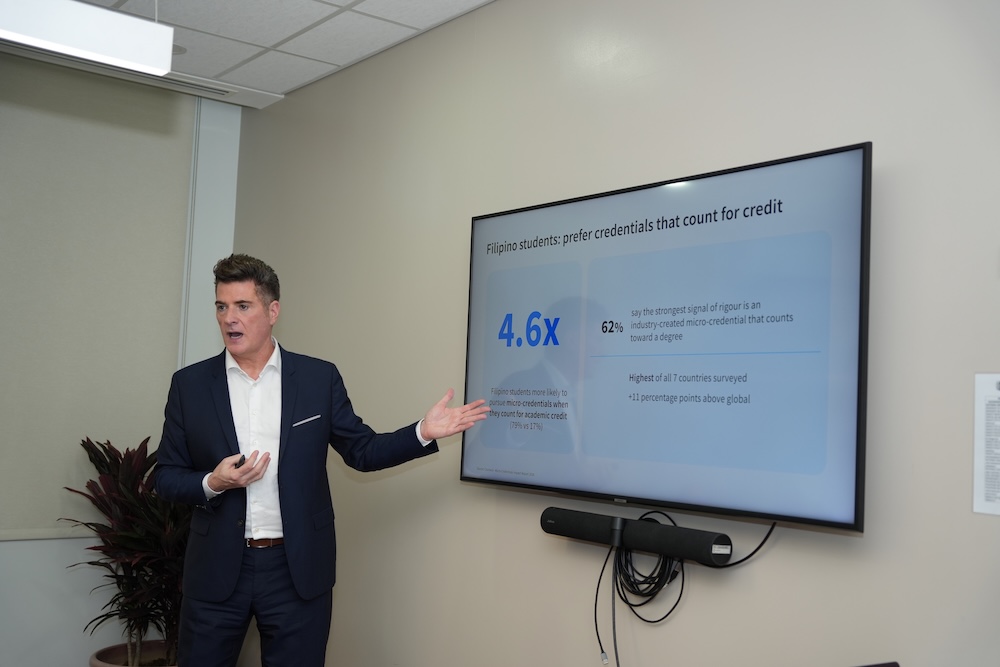
The Coursera report emphasized how these industry-aligned, flexible, short programs are the wave of the future and highly valued by employers, especially when stacked on top of full degrees.
“The Philippines is showing real leadership in building a skills-first higher education system, with CHED’s CMO creating a trusted pathway for flexible, workforce-aligned learning. This regulatory clarity is critical, aligning universities, employers, and learners around credentials that are recognized, stackable, and tied to real workforce needs,” Salcito said.
Known for making professional certificates and full degrees from top universities more accessible online, Coursera highlighted in its report that 85% of Filipino graduates who earned a micro-credential secured a role aligned to their field within 12 months. In fact, 77% of Filipino employers say candidates with micro-credentials move faster through hiring pipelines.
“The best way to do micro-credentials is deeply embedded through the university structure as well,” Salcito explained. “This is not only to instill that lifelong learning foundation into your instruction but to bring the quality of the university systems with this differentiated value from micro-credentials.”
Coursera added that its data shows that employers are willing to pay and recognize the value of the differentiation.
“In the Philippines, 89% are willing to offer higher starting salaries based on micro-credentials,” Salcito said. “Certainly, this is a huge ticket for a candidate looking for jobs, not only to get a better paying job, but obviously differentiate themselves from other candidates in the world of work.”
Ana Maria Bongato, former Executive Director for Talent Development at the IT & Business Process Association of the Philippines (IBPAP) added, “Filipino employers no longer rely only on school reputation or degrees, but are looking for verifiable, job-ready skills as proof of what a candidate can do on day one. Micro-credentials are designed to be more focused and accessible than traditional degrees and get people job-ready faster in growing areas like AI.”
Keeping up with the times
iPeople, Inc., the Yuchengcho-Ayala education partnership that includes Mapúa University, Mapúa Malayan College Laguna, Mapúa Malayan Digital College, Mapúa Malayan College Mindanao, University of Nueva Caceres, and National Teachers College, is one of the first Filipino higher education systems that recognized the value of micro-credentials.
To bolster its progressive approach to learning, iPeople in 2019 became the first educational network in the Philippines to embed Coursera into its curriculum as a supplemental learning resource. The network is Coursera’s third largest campus partner worldwide, supporting the learning needs of 45,000 Filipino students across six schools, giving access to micro-credentials, credit-bearing Generative AI content, and AI tools for self-paced learning to enrich student experience.
“With Coursera’s global credibility, this partnership further drives our mission in producing graduates with the best outcomes in employability. This is our contribution in addressing the skills gap of the Filipino workforce. By futureproofing Filipino talent with industry-recognized skills, we give them the confidence and competencies to adapt to the changing demands of the global and local labor market,” said Dr. Dodjie Maestrecampo, President of Mapúa Education Group.
Dr. Reynaldo Vea, Chairman and CEO of iPeople, Inc. says that “Micro-credentials are linked to real industry and workforce needs, which benefit students because it enhances their hirability.”
