


Anyone who has spent time online has likely encountered Wikipedia and picked up a fact or two from its millions of articles. While it is prudent to not rely on any information from Wikipedia without further research, it is still very useful and deserves its place online after 24 years of existence. As Wired magazine declared back in 2020, Wikipedia is the “last best place on the internet.”
But did you know that Wikipedia can be fun, too?
The English Wikipedia gets edited at a rate of about 1 to 2 times per second and thousands of times every hour. The cool thing about this is that every change is logged and can be accessed via a public application programming interface or API. APIs let apps and services query data from another service and make do with it however they please. In Wikipedia’s case, a few clever coders have created cool toys based on the encyclopedia and its API.
Here are three of them that you can enjoy.
WikiAsteroids (asteroids.wiki)
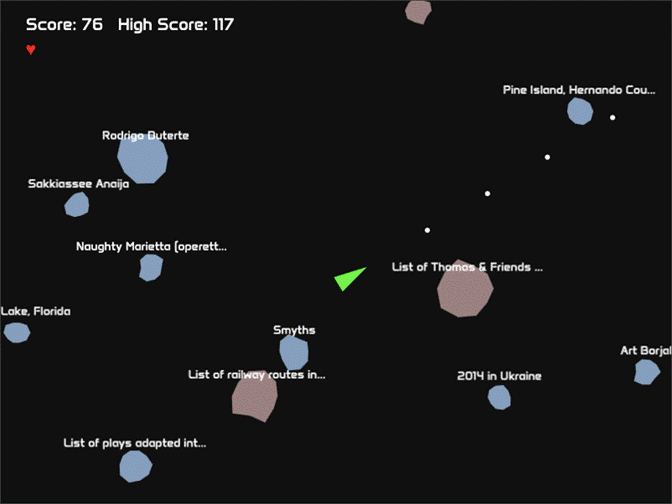
One of the larger asteroids on this screenshot is labeled “Rodrigo Duterte”, which means that the Wikipedia article for the former president had a somewhat large edit done to it recently.
Based on the classic 1979 video game from Atari, WikiAsteroids is a browser-based game that lets you control a little triangular-shaped spaceship navigating an asteroid field. Just like with the original game, your aim is to try surviving for as long as possible by maneuvering your spaceship to avoid the asteroids, or firing your cannon to destroy those pesky space rocks.
In this version, Wikipedia edits replace the original game’s randomness. Each Wikipedia edit spawns an asteroid labeled with the article’s title—the larger the edit, the bigger the asteroid.
To spice things up, when an article is created, an “extra life” powerup appears which you can grab to increase your lives left. But when a new user creates an account, a random powerup appears which can grant you temporary boosts such as a shield or faster cannons, or one that blows up all visible asteroids.
American software developer Kevin Payravi developed WikiAsteroids and released it last March 10, 2025.
Listen to Wikipedia (listen.hatnote.com)
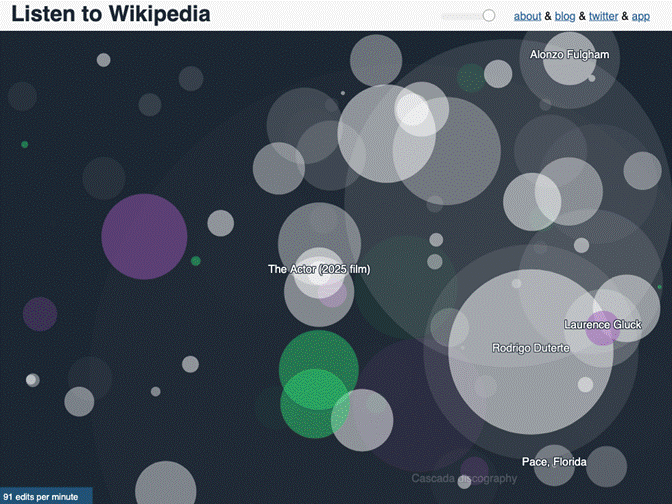
Listen to Wikipedia’s plucked strings and bells are accompanied visually with circles that pop up then slowly fade, including a circle labeled “Rodrigo Duterte.”
If you want something less frenetic, and much more chill and zen than WikiAsteroids, then Listen to Wikipedia might be up your alley.
First published in 2013, this website visualizes real-time edits to Wikipedia by circles that appear then slowly fade whenever an article is edited. The larger the change, the bigger the circle. Each edit is also accompanied by either a bell sound or a plucked metallic string with bells indicating net additions and strings net deletions. And when a new user registers an account, a grand sound swells in.
Think of Listen to Wikipedia as an alternative to your background Spotify playlist. People have been known to use it during their yoga or meditation sessions!
Listen to Wikipedia was co-developed by American lawyer Stephen LaPorte and California-based software developer Mahmoud Hashemi. LaPorte most recently became the General Counsel of the Wikimedia Foundation, the non-profit that hosts and operates Wikipedia.
WikiTok (wikitok.io)



What would it look like if Wikipedia and TikTok had a child? WikiTok might be the answer.
Inspired by an online discussion on X/Twitter about an infinitely scrolling Wikipedia, New York-based software developer Isaac Gemal spent a late night developing the first version of WikiTok which he released on February 4, 2025.
WikiTok presents random Wikipedia articles as individual screens that you swipe up and down similar to TikTok, YouTube Shorts, and Facebook Reels. However, unlike those short-form video sites, WikiTok doesn’t feature any videos—just still background images and a short snippet from the article—and, more importantly, does not include any recommendation algorithm.
TikTok is famous for mining data about which videos you watch and like in order to recommend you with countless other videos that keep you hooked on the site. WikiTok has none of that and it doesn’t need to. Lots of Wikipedia articles are inherently interesting and many people have gone down rabbit holes initially reading up about the 2025 Oscar winners but finding themselves hours later learning about the Norman Conquest of England in 1066.
As Gemal told Ars Technica, “I have no grand plans for some sort of insane monetized hyper-calculating TikTok algorithm. It is anti-algorithmic, if anything.”
